INDIA-AMERICA-BRITISH

WELCOME TO KATY INDIA- ALL THE ARTICLES WRITTEN BY LOKANATH MISHRA ON INDIAN-AMERICAN -BRITISH - SOCIAL AND CULTURAL MATTERS ARE BEING RE PRODUCED IN THIS BLOG POST
LORD SHRI JAGANNATH & LORD SHRI KRISHNA ARE MAHA VISHNU.SHRI JAGANNATH IS BEING WORSHIPED THROUGHOUT THE WORLD.

Tuesday, 2 October 2018

DRI Chennai seized Cigarettes valued at Rs. 4.26 cr.from a consignment from Dubai, declared as “calcium carbonate”. “Gudang Garam” brand cigarettes were concealed among the calcium carbonate bags. 4 persons including the importer and Customs Broker have been arrested
 

Monday, 1 October 2018

Gandhi Jayanti 2018: Importance and Significance of Gandhi Jayanti in India

Gandhi Jayanti 2018: Mahatma Gandhi fought against caste system and was instrumental in abolishing the practice of untouchability. He also preached non-violence (ahimsa) and spoke about its significance.

gandhi jayanti, gandhi jayanti 2018, gandhi jayanti significance, gandhi jayanti 2018 india, mahatma gandhi birthday, mahtma gandhi birth anniversary, gandhi jayanti 2018 india, gandhi jayanti importance in india, gandhi jayanti significance in india, gandhi jayanti history
X
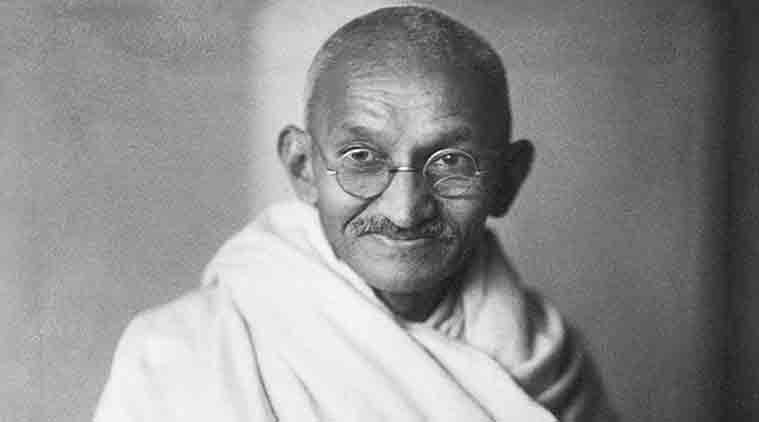
Mahatma Gandhi preached non-violence and spoke about its significance. (Source: File Photo)
Mohandas Karamchand Gandhi, born on October 2, 1869, remains one of the prominent faces of India’s struggle for freedom. Fondly known as Mahatma, he fought against caste system and was instrumental in abolishing the practice of untouchability. He also preached non-violence (ahimsa) and spoke about its significance.
Mahatma Gandhi’s words, actions and methods won over the masses and as a result, several joined him as he led the Dandi Salt March in 1930. In 1942, he launched the Quit India Movement.
The United Nations General Assembly, in order to commemorate Gandhi’s ahimsa philosophy had voted to establish October 2 as the International Day of Non-Violence on June 15, 2007.  The day seeks to “disseminate the message of non-violence, through education and public awareness”. The resolution reaffirms “the universal relevance of the principle of non-violence” and the desire “to secure a culture of peace, tolerance, understanding and non-violence,” the website informs.
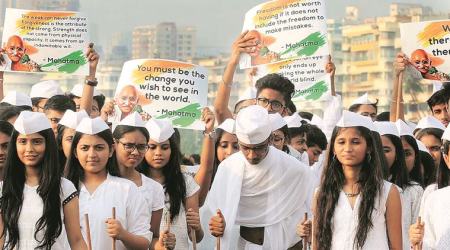
Remembering the leader and his contribution, every year on October 2, Gandhi Jayanti is celebrated across the globe. His teachings are reiterated and his words are revisited. Several schools arrange functions and people from different walks of life, caste and religion unite to mark this day.

 Majority of India's Workforce Draws Salary Below CPC Recommendations, Says Report


According to the report, 82 per cent of male and 92 per cent of female workers earn less than Rs 10,000 a month.
New Delhi, Oct 1: While the central government has approved recommendations of the 7th Pay Commission, a majority of workers in India get a monthly salary which is less than what was recommended by the 7th CPC, according to a report, which was released by the Centre for Sustainable Employment of the Azim Premji University.

According to the report, 82 per cent of male and 92 per cent of female workers earn less than Rs 10,000 a month. Notably, the 7th Pay Commission recommended Rs 18,000 as the minimum salary for a month for central government employees. “This suggests that a large majority of Indians are not being paid what may be termed a living wage, and it explains the intense hunger for government jobs,” stated the report.
The report, ‘State of Working India 2018’, also said the country has the highest rate of unemployment in 20 years. It also said the open unemployment is also rising among the educated youth in the country.

“Even as GDP growth rates have risen, the relationship between growth and employment generation has become weaker over time. In the 1970s and 1980s, when GDP growth was around 3-4 per cent, employment growth was around 2 per cent per annum. Since the 1990s, and particularly in the 2000s, GDP growth has accelerated to 7 per cent, but employment growth has slowed to 1 per cent or even less. The ratio of GDP growth to employment growth is now less than 0.1," it stated.

'The truth of non-violence, he repeated, could never be challenged'


'A little old man who has renounced personal possessions, walking with bare feet on the cold earth in search of a great human ideal'.
Mahatma Gandhi
Phillips Talbot then the South Asia correspondent of the Chicago Daily during Independence, was an eyewitness to history. He traveled to Noakhali, present day Bangladesh, and spent time with Mahatma Gandhi during the communal violence there.
In a fascinating letter to a friend in New York, he conveyed his impressions of his encounter with the Mahatma.
Then president emeritus at the Asia Society, New York, Mr Talbot kindly granted Rediff On The NeT -- as Rediff.com was known in 1997 -- permission to publish this letter from his archives.
We republish the four-part feature to salute a man of whom Albert Einstein said: 'Generations to come will scarce believe that such a one as this ever in flesh and blood walked upon this earth.'
22 Ferozshah Road
New Delhi, India
February 16, 1947
Mr Walter S Rogers
Institute of Current World Affairs
522 Fifth Avenue
New York 18, New York
 
Dear Mr Rogers,
Two weeks ago I traveled for five days in order to walk for an hour with Gandhi.
The journey was worth the effort.
It was revealing to watch Gandhi throwing himself during this critical season into the remoteness of East Bengal's Noakhali district for a barefooted village-to-village pilgrimage in search of Hindu-Muslim amity.
Here was a 77-year-old ascetic, rising above the physical ordeal, immersed in a peculiarly Indian approach to the cleavage that threatens the country.
The region in which Gandhi has secluded himself is deep in the Ganges-Brahmaputra delta; one of the least accessible flat lands of India. To reach his party, I traveled by air, rail, steamer, bicycle, and on foot.
Hardly a wheel turns in this teeming, jute-and-rice-growing delta. I saw no motorable road. The bullock cart, one of India's truest symbols, does not exist here.
The civilisation is amphibious, as fields are always flooded between April and October. In the wet season little remains above water except occasional ribbons of bund and isolated village clumps marked by coconut palms, bamboos, and betel trees.
People stay at home or, at best, move about in hand-hewn skiffs. Though some of their crops grow under water, they farm mostly in the winter dry season.
Here, in an entirely rural area about forty miles square, are jammed nearly two-and-a-half million people: 1,400 per square mile or more than two per acre. Eighty per cent of these peasants are Muslims.
Apart from a few wealthy families they "have nothing but their numbers", in the words of one senior Muslim official.
Impoverished cultivators racially indistinguishable from their Hindu neighbours, they suffered severely in the 1943 Bengal famine.
The tiny Hindu minority in this region is divided into two groups, of whom the more numerous are also peasants and low caste village artisans.
With the upper crust of landlords, moneylenders, grain merchants, and lawyers, peasants of both communities had shared little sympathy for many years past, I judged.
 
In this closely-packed, rupee-starved, isolated district, terror struck last fall in the wake of vicious riots in Calcutta and other Indian cities.
It was the first real flare-up in a rural area. Roving bands paddled over the flooded fields from village to village, killing Hindus, looting and burning their property, abducting some women, and registering conversions from Hinduism to Islam.
Many of those murdered and robbed were the wealthy who had incurred the peasants's ire in 1943. The movement took a communal twist, however, from politicians (since disowned by the Muslim League) who led the village crowds with the cry of Pakistan.
In some villages mobs burned huts even of outcastes. The upheaval swept over about half the district.
Perhaps a million people were caught up in the turmoil, and refugees eventually were counted in tens of thousands. This was bad enough. But the effect was multiplied a thousand-fold across the breadth of Hindu India by exaggerated, inflammatory reports of what had occurred.
This was the pitch of feeling in India when Gandhi decided to go to East Bengal himself.
A few days before he left Delhi, Mildred and I walked with him for half an hour in the sweepers' settlement where he stayed and talked of the wave of mass fratricide which was then rolling over the country.
Although he denied letting emotions affect his judgement, we sensed a feeling of frustration, if not of failure.
This had nothing to do with the validity of the creed of non-violence itself. Its truth, he repeated, could never be challenged. But he could not be happy with the way in which his teachings were being flouted.
To test the applicability of his faith, therefore, he went to the heart of the trouble. He chose East Bengal, and when people asked why he had not gone to Bihar province where the damage was greater and the culprits were Hindus, he replied that the people of Bihar had repented.
Besides, he said, he could control the government and people of Bihar from Noakhali, but had no special powers over the people of Noakhali.
In a tiny village that suddenly acquired fame, bustling visitors, police attendants, press observers and even telegraph facilities, the old man settled into a hut and began meeting people, hearing their stories and assessing the task ahead of him.
Finally, early in January, he began the trek that will take its place in the Gandhi epic as the East Bengal March.

GST collection for September surges but fails to meet Rs 1 lakh-cr target


GST collection for September surges but fails to meet Rs 1 lakh-cr target

The Finance Ministry has targeted monthly GST collections to be Rs 1-lakh crore for this fiscal, but the actual mop up has fallen short of the target month after month, except April. 
The GST revenue collection for September crossed Rs 94,000 crore as compared to Rs 93,960 crore in August. The latest GST number remains broadly on expected lines but falls short of the Rs 1 lakh crore target, say analysts. The total gross GST revenue collected in September is Rs 94,442 crore, of which CGST (central tax) amounts to Rs 15,318 crore, SGST is Rs 21,061 crore, and IGST is Rs 50,070 crore.
In a statement, the Ministry of Finance said the IGST of Rs 50,070 crore includes Rs 25,308 crore collected on imports, and cess of Rs 7,993 crore (including Rs 769 crore collected on imports). The total number of GSTR 3B returns filed for August up to September 30 is 67 lakh."
The total revenue earned by the central government and the state governments after settlement in September is Rs 30,574 crore for CGST and Rs 35,015 crore for the SGST, the ministry said, adding the revenue collected in September shows an upward trend as compared to the August collection.
The GST revenue collection for July was Rs 96,483 crore. The tax revenue from the GST collection increased as compared to Rs 95,610 crore during June. The collections stood at Rs 94,016 crore in May. The Finance Ministry has targeted monthly GST collections to be Rs 1 lakh crore for this fiscal, but the actual mop up has fallen short of the target month after month. The sole exception was April in which the numbers exceeded Rs 1 lakh crore.
Meanwhile, the GST Council last week set up a seven-member ministerial panel under Bihar Deputy Chief Minister Sushil Modi to examine the legality of imposing a new tax on certain goods and services to raise resources for natural calamity-hit states like Kerala. The panel, headed by Union Finance Minister Arun Jaitley and comprising representatives of all states and UTs, also took stock of the shortfall in tax mop up by majority of the states under the new indirect tax regime.

SC/ST Job Promotion Reservation & OBC Division: BJP’s Weak Nerves?

A government that was visibly ambitious in the initial stages of the fight for reservations in job promotions for SC/ST, seems quite indecisive after the Supreme Court verdict.
The matter of quota for job promotions for SC/ST was stuck since the Nagaraj verdict in 2006. That verdict put forth three conditions which practically stopped reservations in promotions.
The conditions were:
  • Backwardness should be proved on the basis of facts.
  • The low numbers of SC/ST candidates in job promotions should be provided.
  • It should be ensured these promotions don't have adverse effects on the administration.
There was no development or decision taken by the then Congress government in this regard for the next 8 years. A bill was then introduced in the Parliament by the UPA which was never passed, citing opposition by the Samajwadi Party.
After NDA came to power in 2014, multiple petitions were filed in the Supreme court challenging the Nagraj verdict which were backed by the NDA. The government was clearly and ambitiously backing reservations. Then why is the BJP/NDA silent after the recent SC verdict?
Ministers like Ramvilas Paswan and Ramdas Athawale have spoken, but it's difficult to understand if the views are the party's or their own. The court's verdict has further sparked off a debate of the issue of creamy layer. The creamy layer, until now, was applicable only for the OBCs. In it's verdict, the Supreme Court "suggested" that creamy layer should be introduced for SC/STs as well.
Bone in the BJP's Throat
The BJP does want to appease the SC/STs by abiding by the Supreme Court verdict but is facing difficulties in doing so.
After the SC allegedly weakened the SC/ST Act, the BJP restored the act via the Parliament to its original form, but it is upset over the fact that BJP's core upper caste voters are not very happy about it. Therefore, BJP possibly cannot afford to do so. Hence, the BJP might not take any concrete steps in this regard and try avoiding the issue for the next few months.
Division of OBCs
On 2 October 2017, the BJP set up an ambitious commission for the division of the OBCs, the head of which was retired judge G Rohini. The Commission was given three tasks:
  • To analyse the ease of getting jobs for different castes and sub-sections under OBC.
  • To chalk out ways for the division of OBCs.
  • To recognise different castes under OBC, in order to divide them into sub-classes.
The Commission was given 12 weeks to file a report, but it has been over 12 months now with no further development in this regard. According to sources, the Commission has prepared an interim report, which the Centre hasn't seen. The tenure of the Commission has now been extended to 20 November.
Centre Split?
The OBC vote is crucial for the BJP. If the Mandal Commission is to be believed, they comprise of 52 percent of the country's population. The Centre, however, is split when it comes to the division of the OBCs.  One section thinks that the division of OBCs will empower the weaker sections of OBCs more than they ever were and this might not go down well with the stronger, influential sections.
Moreover, if one section of the OBCs is declared more empowered than the others, how much reservation will they be entitled to? These matters might lead to a political storm across the country. Moreover, these matters are being perceived as the weak nerve of the BJP.
CCS (REVISED PAY) RULES, 2008 - SECTION II OF THE PART "A" OF THE FIRST SCHEDULE THERETO- ENTRY PAY FOR DIRECT RECRUITS APPOINTED ON OR AFTER 01.01.2006 AND PAY FIXATION IN THE CASE OF PERSONS OTHER THAN SUCH RECRUITS (Click the link below to view)
  https://doe.gov.in/sites/default/files/entry%20pay%20english.pdf